Profitability and diversification in real estate investment

Invest in selected real estate projects and build a more diversified portfolio by type of operation, term, location, and risk profile.

At Urbanitae, you can access debt and equity real estate investment opportunities from €500, with clear information before investing and monitoring throughout the process.
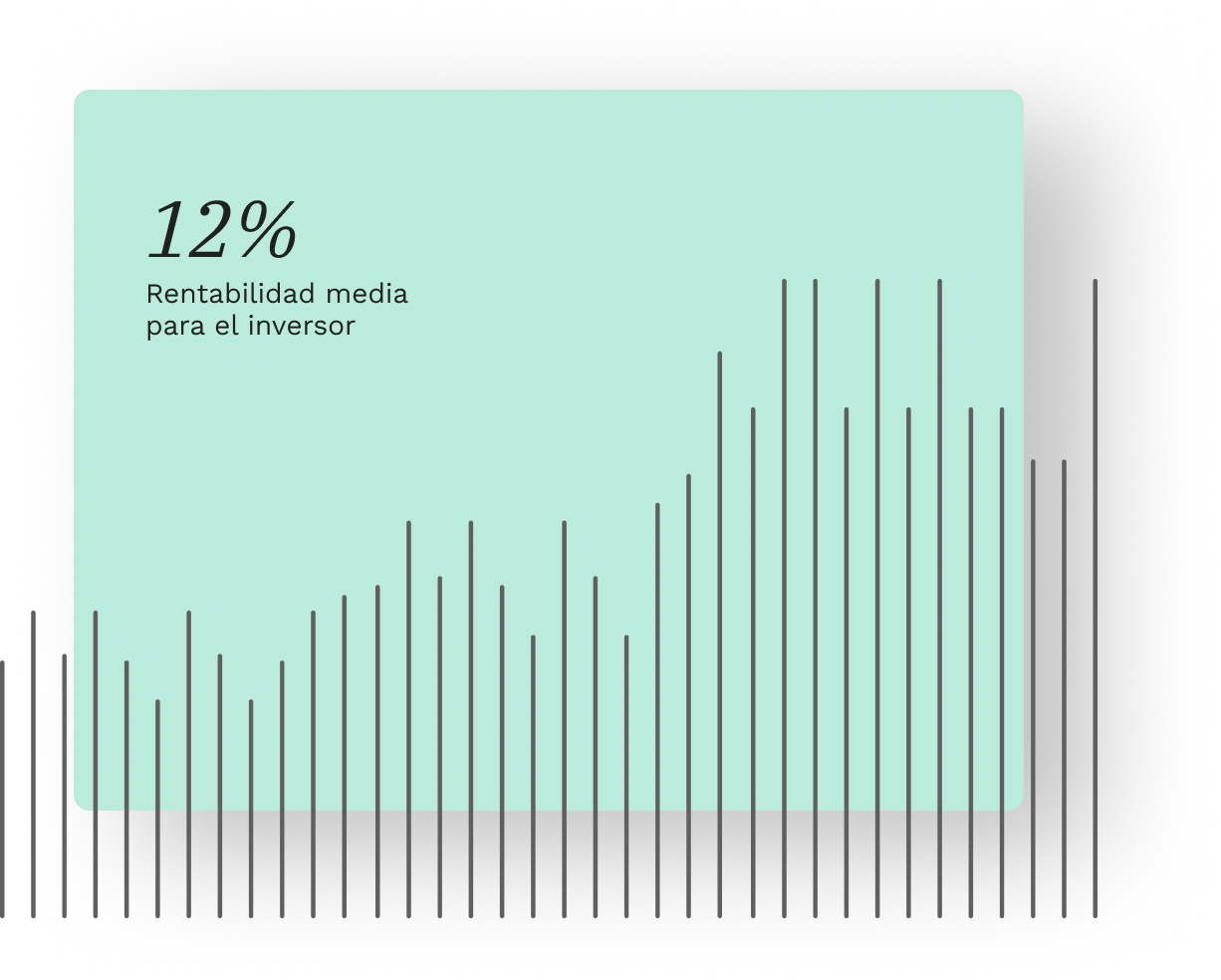
Average profitability chart

funded in real estate projects

12%

average return for investors

funded homes in Spain

CNMV

authorized and supervised platform

Real estate profitability:
more than just a percentage

The return on a real estate investment does not rely solely on the expected return.
The term, risk, liquidity, and type of project also play key roles.

Before comparing opportunities, it is essential to consider:

Total return

Expected profit on invested capital.

Annualized return

Return adjusted to the investment term.

Time horizon

Investing for 12 months is not the same as for 36 months.

Assumed risk

Every project has a distinct structure and profile.

Liquidity

Some investments do not allow capital retrieval before maturity.

Investing wisely is not just about seeking the highest return. It is about understanding where it comes from and whether it aligns with your goals.

How to calculate the return on a real estate investment

A simple way to calculate gross return is to divide the profit obtained by the initial investment and multiply by 100.

Formula
Return =
profit obtained initial investment
× 100

For example, if an investment of €10,000 generates a profit of €1,000, the total return would be 10%.

Real estate debt Defined interest from the start.
Equity Participation in project capital gains.
Rental yield Income linked to asset leasing.
Capital appreciation Increase in property value over time.

To compare projects with different terms, it is best to focus on annualized metrics such as the IRR.

How to diversify your real estate investments

Diversifying means allocating capital across opportunities with distinct characteristics. It is not about investing in many projects without criteria, but rather about reducing reliance on a single operation.

You can diversify by:

Type of operation

Debt or equity

Term

Short, medium, and long-term projects

Location

Different cities, regions, or countries

Segment

Residential, commercial, office, hotel, flexible living, or alternative assets

Developer

Different management teams and strategies

Risk profile

Secured operations, development projects, or income-generating assets

Diversification does not eliminate risk, but it helps build a more balanced portfolio.

How to build a diversified real estate portfolio

Each project type can serve a specific function within the portfolio. There is no single formula: each investor must evaluate their time horizon, risk tolerance, and goals.

Objective Project type Role in portfolio
Greater predictability Debt Defined interest and term
Higher return potential Equity Participation in capital appreciation
Geographic diversification Multiple locations Reduced exposure to a single market
Capital turnover Shorter terms Opportunity for earlier reinvestment
Objective Debt

Greater predictability

Defined interest and term

Objective Equity

Higher return potential

Participation in capital appreciation

Objective Multiple locations

Geographic diversification

Reduced exposure to a single market

Objective Shorter terms

Capital turnover

Opportunity for earlier reinvestment

There is no single formula. Each investor must evaluate their time horizon, risk tolerance, and goals.

Real estate investment risks and risk diversification

All investments involve risk. Real estate investment is no exception.

Key risks include:

Delays in execution or commercialization Cost overruns or business plan adjustments Adverse market or demand trends Lack of liquidity during the investment term Partial or total loss of invested capital

Risk diversification helps prevent a single investment from dictating the entire portfolio. However, it does not guarantee returns or eliminate losses.

Investment risks

Invest in real estate projects with Urbanitae

Urbanitae allows you to invest in real estate projects from €500, alongside other investors and 100% online.

Before investing, you can review each opportunity with clear information regarding:

01

The operation

Project type, strategy, and use of funds

02

The asset

Location, features, and target market

03

The return

Target or estimated return and expected term

04

The risk

Key risk factors and guarantees, where applicable

05

The developer

Experience, track record, and role in the project

Unlock access to a diversified real estate portfolio

Furthermore, once the project is funded, Urbanitae conducts periodic monitoring and publishes regular updates for investors

Frequently asked questions

It depends on the type of operation, term, risk, location, asset, and developer. At Urbanitae, each project displays its target or estimated return before you invest.

A simple way is to divide the profit obtained by the initial investment and multiply by 100. To compare investments with different terms, it is best to look at annualized metrics such as the IRR.

No. Returns are not guaranteed. All investments involve risk, including the potential partial or total loss of invested capital.

You can diversify by type of operation, location, term, developer, real estate segment, and risk profile. The goal is to avoid relying on a single project or market.

It is a portfolio made up of various real estate investments combining different return profiles, risk levels, terms, and locations.

In debt, the investor acts as a lender and usually knows the interest rate and term from the start. In equity, they participate in the project's capital and their return depends on the final outcome.

There can be delays, cost overruns, lower demand than expected, lack of liquidity, or capital loss. That is why analyzing each project and diversifying is essential.

At Urbanitae, you can invest from €500 per project, allowing you to spread your capital across different real estate opportunities progressively.